
How to Sell More Books on Amazon: A Practical Guide for UK Business Authors

Write Business Results’ Bestselling Book Launch Campaign achieved a three-year #1 Amazon bestseller streak: every title launched through that campaign reached number one in at least one relevant Amazon category. That covered dozens of books, with many reaching multiple number ones across categories and countries.
That record relates specifically to titles using the campaign, rather than every book we helped publish. It describes category achievements during that period, not continuous number-one rankings or a promise of future results. After 11 years of helping authors publish and make more of Amazon, we have learned plenty about what helps, what needs attention and what to avoid. We watch Amazon’s changes and update our campaigns regularly.
Amazon began as an online bookstore. It remains a place people visit to find a title they already know and discover one they have never heard of. For your book, that means both search and discovery matter. Making it available is the beginning; helping the right reader recognise its value is ongoing work.
This guide explains how to sell more books on Amazon as a UK-based author, whether you self-publish or work with a traditional publisher. We will connect the practical details with the bigger question: what do you want those readers, sales and relationships to make possible?
Find the part you need
- Amazon and your commercial goals
- What you and your publisher control
- Search, discovery and rankings
- Publishing and distribution
- Covers, descriptions and samples
- Keywords and categories
- Author Central and A+ Content
- Pricing and Kindle promotions
- Amazon Ads and their economics
- Email, social media and launch activity
- Reader reviews
- Business opportunities and measurement
- Questions about selling books on Amazon
Why does Amazon matter if my book supports a business?
Amazon matters because it can help people find, assess and buy your book, including people outside your existing network. For a business author, those readers may also become clients, event organisers, collaborators or advocates for your work.
Your largest return may come through lead generation, better-paid speaking engagements, strategic partnerships or an opportunity you had not anticipated when writing. Royalties are one measure of value. A reader who recognises a problem and wants your help applying the book’s ideas creates a different kind of opportunity.
For a traditional publisher, book sales are the commercial foundation. Authors across genres are expected to participate in reaching readers, although the activity and responsibilities vary. Penguin’s explanation of book promotion describes authors and publishing teams collaborating on campaigns.
Strong sales give a publisher evidence to support further investment. That may mean continued promotion, additional formats, new editions or interest in foreign and translation rights, where it holds those rights. Success may also strengthen your position when discussing a second book and a possible advance. These are commercial decisions, influenced by demand, costs, rights and the next proposal.
What can I control on Amazon, and what does my publisher control?
You can usually influence more than you think: your author presence, the material you supply, your outreach and how you invite people to explore the book. Direct control of the listing depends on who publishes and distributes each edition.
| Area | Self-publishing through your KDP account | Traditional publication |
|---|---|---|
| Book details and files | You or your authorised publishing team submit permitted updates. | Your publisher normally manages submissions. Supply proposed improvements. |
| List price and promotions | You choose within the relevant programme rules; Amazon may set the retail price. | Coordinate changes with your publisher. |
| Author presence and outreach | Maintain your profile and campaign activity. | Claim your author presence and agree how your activity supports the campaign. |
| Advertising | Check account and book eligibility, then manage or commission campaigns. | Agree who advertises, pays and shares results before running overlapping campaigns. |
A useful publisher conversation is specific: “Can we strengthen the description’s opening, check the UK categories and agree a promotional window?” Provide suggested wording and a reason. A clear request is easier to act on than a general concern that the book needs more visibility.
How do Amazon search, discovery and bestseller rankings work?
Search starts with a reader typing a title, topic or problem. Discovery can happen without that search: someone browses a category, follows recommendations or notices a related book. Amazon can therefore introduce your expertise to people who have never encountered your business.
There are several decisions in that journey. First, your book needs to be relevant to the search or placement. Next, the cover and title must earn attention. Then the description, sample, price and supporting information must help the reader decide to buy. This is a practical way to diagnose marketing, not Amazon’s published algorithm.
Amazon’s search guidance identifies factors including past sales, availability and popularity. Its listing guidance also identifies keywords, book details and book text as information used in search. Results change; a first-page position is not permanent.
Sales rankings measure something different. Amazon’s ranking guidance describes recent and historical activity relative to other books. Category and overall ranks differ, and free and paid Kindle charts are separate. Neither a bestseller badge nor an advertising placement guarantees a strong organic search position.
For your business book, ask where readers lose interest before spending more. Poor visibility calls for different work from a page that attracts unsuitable clicks. Amazon does not disclose its full recommendation formula: a magic review count, alleged “A10” shortcut or universal conversion threshold is not a reliable strategy.
How do “Customers also bought” recommendations work?
These recommendations use relationships between shopping activity, rather than a slot an author can claim. Amazon Science’s explanation describes identifying products that buyers of one item are unusually likely to buy compared with other shoppers. That explains the principle, not the full formula behind every current recommendation carousel.
Reach readers who genuinely share the interests of the audience you want: through relevant podcasts, professional communities, newsletters and comparable subject matter. That may create useful audience overlap, but there is no guaranteed number of shared purchases that puts your book beside a bestseller. Avoid coordinated purchases designed to manufacture associations.
If you want a controlled way to seek visibility around a relevant book, investigate Amazon Ads product targeting. Eligible ads can appear on product detail pages, subject to the auction and placement rules. A sponsored placement is separate from an organic recommendation; paying for one does not buy the other.
How should I prepare for self-publishing on Amazon?
Prepare for self-publishing on Amazon by settling your rights, editions, production quality, publishing account and route to market before announcing availability. An Amazon listing cannot compensate for a book that disappoints its intended reader.
For your own manuscript, Kindle Direct Publishing is the publishing route to investigate. Seller Central, used-book reselling and fulfilment services address different needs. You do not need to build a general retail business to publish your own book through KDP.
Prepare the edited manuscript, professional cover, print and ebook files, description, keywords, categories and pricing. Review a proof and test the ebook’s navigation. If a publishing service handles setup, establish who controls the account, receives royalties and approves updates.
Amazon can sit alongside wider distribution. Make sure your arrangements across KDP, your distributor and other retailers fit together, including edition details and any exclusivity. Avoid creating duplicate listings as a visibility tactic. Readers need a clear, reliable way to buy the correct book.
How can I make my Amazon book listing more persuasive?
Make the listing persuasive by answering three reader questions quickly: is this for me, what will I gain, and why should I trust this author? Your cover, description and sample should give consistent answers.
What should my cover communicate?
Your cover should make sense at thumbnail size and signal the kind of book readers are considering. Test it beside relevant titles on Amazon.co.uk. Is the title readable, does the design suit the subject, and would your intended reader recognise a book worth investigating?
A consultant seeking corporate speaking work may also use the cover in event materials and proposals. Consider whether it represents the professional positioning you want, as well as attracting a click. If you revise a published cover, coordinate the physical book and digital listing.
Make your book stand out in the scroll. Amazon’s pale page backgrounds can swallow the edges of a white or off-white cover. A fine border, a contrasting colour block or a stronger visual edge can help the book retain its shape. Check it against both white and pale grey backgrounds, at the size it appears on a phone.
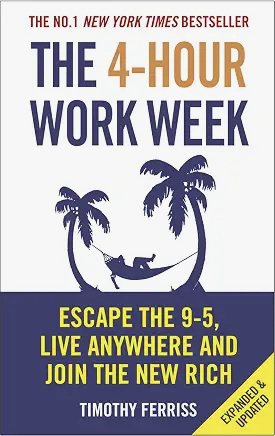
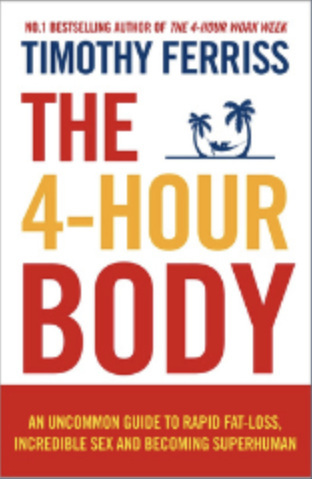
These Ferriss covers use large type and strong colour blocks to hold attention despite their pale backgrounds. Shrink your own cover before approving it: can you read the title and distinguish the book from its surroundings without zooming in?
How should I write the description?
Open with the reader’s situation and the book’s central promise, then explain the approach and useful outcomes. Include relevant author background without making the biography do the description’s job. Amazon’s description guidance supports readable formatting and sets a 4,000-character limit.
Use subject language naturally. A leadership reader should be able to recognise delegation, management or decision-making where those subjects genuinely belong. A description is persuasive copy, not a place to paste a list of search terms. KDP’s metadata rules prohibit keyword or book-tag phrases in descriptions; do not confuse meaningful sentences with keyword stuffing or claim repetition guarantees rankings.
What does a strong description do that a vague one misses?
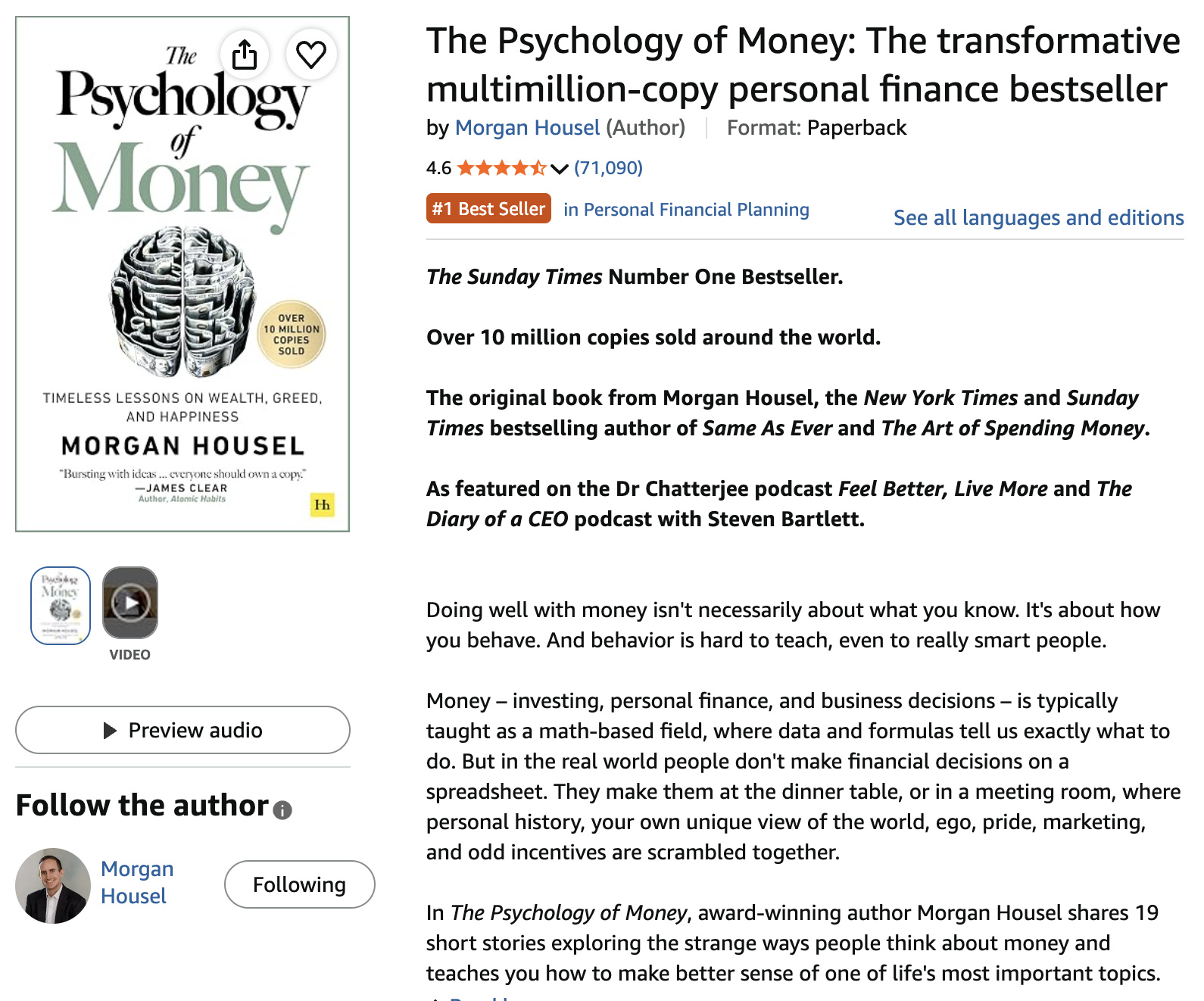
Here are two descriptions for the same book: Morgan Housel’s The Psychology of Money. The first reproduces the description shown in the screenshot below. The second strips away the detail.
Amazon description
The Psychology of Money
Morgan Housel
The Sunday Times Number One Bestseller.
Over 10 million copies sold around the world.
The original book from Morgan Housel, the New York Times and Sunday Times bestselling author of Same As Ever and The Art of Spending Money.
As featured on the Dr Chatterjee podcast Feel Better, Live More and The Diary of a CEO podcast with Steven Bartlett.
Doing well with money isn't necessarily about what you know. It's about how you behave. And behavior is hard to teach, even to really smart people.
Money – investing, personal finance, and business decisions – is typically taught as a math-based field, where data and formulas tell us exactly what to do. But in the real world people don't make financial decisions on a spreadsheet. They make them at the dinner table, or in a meeting room, where personal history, your own unique view of the world, ego, pride, marketing, and odd incentives are scrambled together.
In The Psychology of Money, award-winning author Morgan Housel shares 19 short stories exploring the strange ways people think about money and teaches you how to make better sense of one of life's most important topics.
Vague rewrite (illustrative)
The Psychology of Money
Morgan Housel
A book about how people think and behave.
As an Amazon Associate I earn from qualifying purchases.
The original gives readers a clear subject, a distinctive perspective, a sense of the reading experience and reasons to trust the author. Its language connects money with investing, personal finance and business decisions. The vague one-liner could describe hundreds of unrelated books. It gives a prospective reader little help deciding whether this one addresses their needs.
Your business book needs that same clarity. Explain the problem it tackles, the approach you take and what readers can expect to gain. Make every paragraph help someone decide whether your expertise is relevant to them.
What should I check in the sample?
Read the sample as a prospective buyer. Can they reach useful substance, understand the structure and get a feel for your voice? Amazon’s Read Sample guidance explains availability and format differences, including limitations for print samples on mobile. Check the actual customer experience rather than assuming every device shows the same thing.
Where should I put keywords for Amazon books?
Amazon SEO for books involves several fields with different jobs. Make them work together: an appealing title, a clear promise, accurate publishing metadata and relevant advertising targets.
Title and subtitle: attention, then the reader promise
A business book title often works best when it is punchy and memorable. It does not have to explain the whole subject. The subtitle can carry the reader promise: who the book helps, what changes and why that change matters.
Tim Ferriss’s The 4-Hour Workweek creates immediate curiosity. Its subtitle, “Escape 9-5, Live Anywhere, and Join the New Rich”, makes the desired transformation tangible. This illustrates positioning; it does not establish which words generate Amazon searches.
Your subtitle is also a valuable opportunity for relevant keywords. For a book about developing managers, language around delegation or leadership can clarify an otherwise abstract title. Keep the promise readable and truthful. Follow Amazon’s metadata rules and match the published title and subtitle; do not append an extra keyword list to the listing.
Backend keywords: up to seven entries
KDP permits up to seven keyword entries, including short phrases, rather than only seven individual words. Use the keyword guidance to select accurate language that adds useful information beyond your title and categories. Avoid unrelated author names, misleading claims and redundant variations.
Begin with your reader’s problem, role and desired result. For a leadership book, “first time manager” and “delegating decisions” might be research starting points, not verified high-volume terms. Try them in Amazon.co.uk’s Books search, inspect suggestions and check whether the results serve your intended audience.
How can Google, AI and research tools help?
Type a reader problem into Google and note the language in autocomplete, related searches and People also ask, where displayed. A founder may describe the issue as “my team relies on me for everything” rather than use your framework’s name. Translate that language into candidate book searches, then test relevance on Amazon.co.uk. Google suggestions are clues, not Amazon search-volume evidence.
Publisher Rocket supports UK marketplace research and can help investigate keywords, categories and advertising ideas. Other options include Amazon’s own search suggestions and advertising reports, alongside general keyword tools. Check which marketplace and data source a tool actually covers before interpreting its estimates.
AI can expand and organise ideas. Try: “Suggest phrases a UK business owner might search when struggling to delegate. Group them by problem, audience and outcome; do not invent search volumes.” Review the suggestions against your manuscript and real results. Tools speed up research; they cannot make an irrelevant phrase relevant.
Why do categories matter, and who chooses them?
Keywords connect your book with searches; categories place it on browsable shelves. Together, they help Amazon understand where it belongs and help suitable readers find it. A category also defines the books against which its category ranking is measured. Choose for relevance and reader demand, rather than an easy badge in an unrelated subject.
Under Amazon’s category guidance, you select up to three categories using your primary marketplace and audience. Categories and keywords help determine placement; Amazon reviews selections and may change categorisation. Different formats and countries can have different shelves. Your choices are inputs, not a guarantee of permanent placement.
In KDP, open the book’s menu, choose Edit details, check Primary Audience and Primary Marketplace, then edit Categories, save and submit. Allow up to 72 hours for changes to display. Check the live UK page afterwards. If a category is unavailable, accurate keywords can help Amazon determine placement. For traditionally published books, send the proposed changes to your publisher.
Why is my Amazon author page worth building out?
Think of your Amazon author page as a shopfront for your published expertise. A reader who discovers one title can explore your biography and other work in the same place. For a business author, that helps turn interest in a single book into a fuller understanding of your perspective and experience.
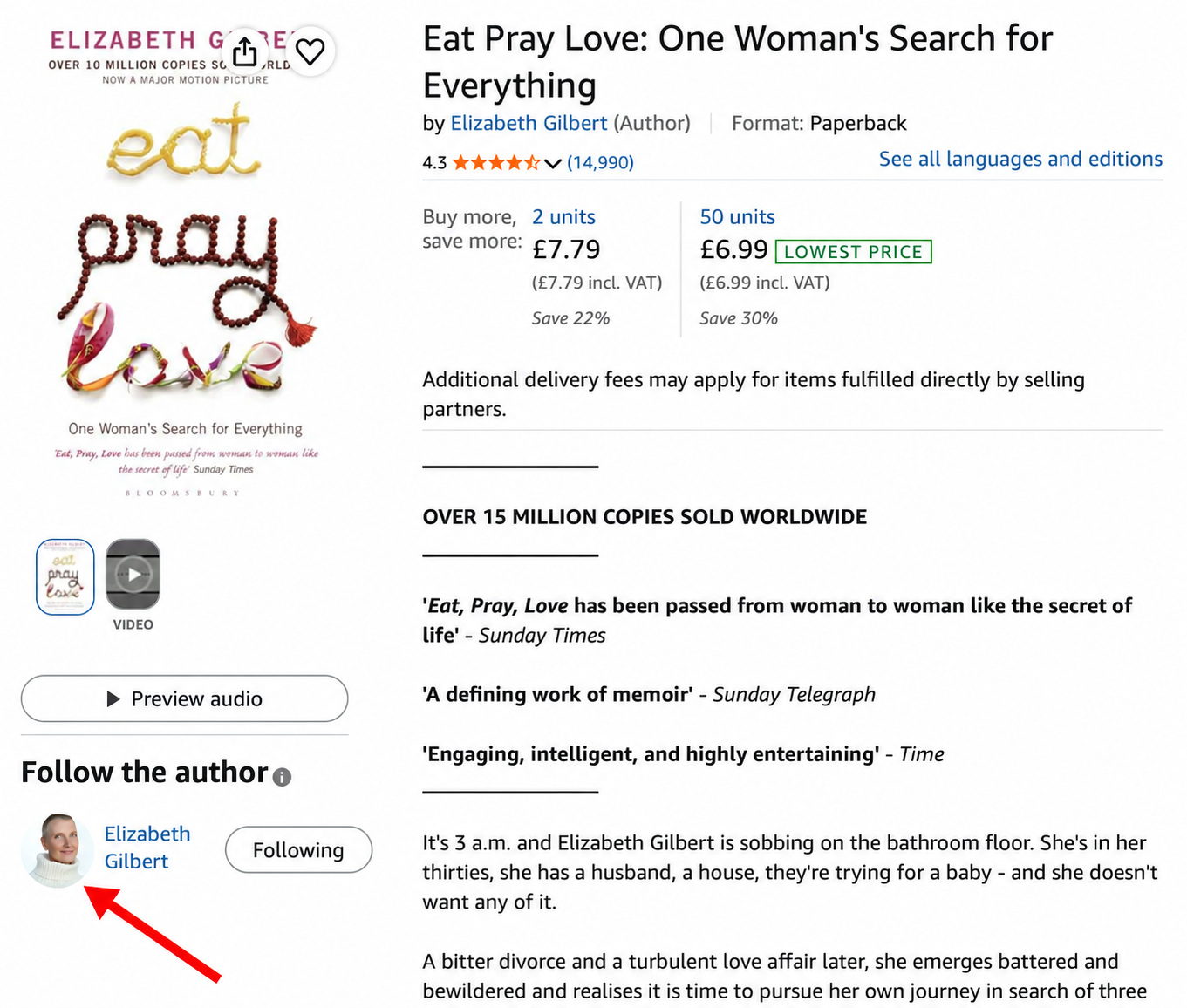
Readers can reach the page through your author name or photograph on a book’s product page. Amazon customers can also follow you from either page. In the screenshot below, the red arrow points to Elizabeth Gilbert’s author area beneath the cover. The button says “Following” because the customer who captured it already follows her.
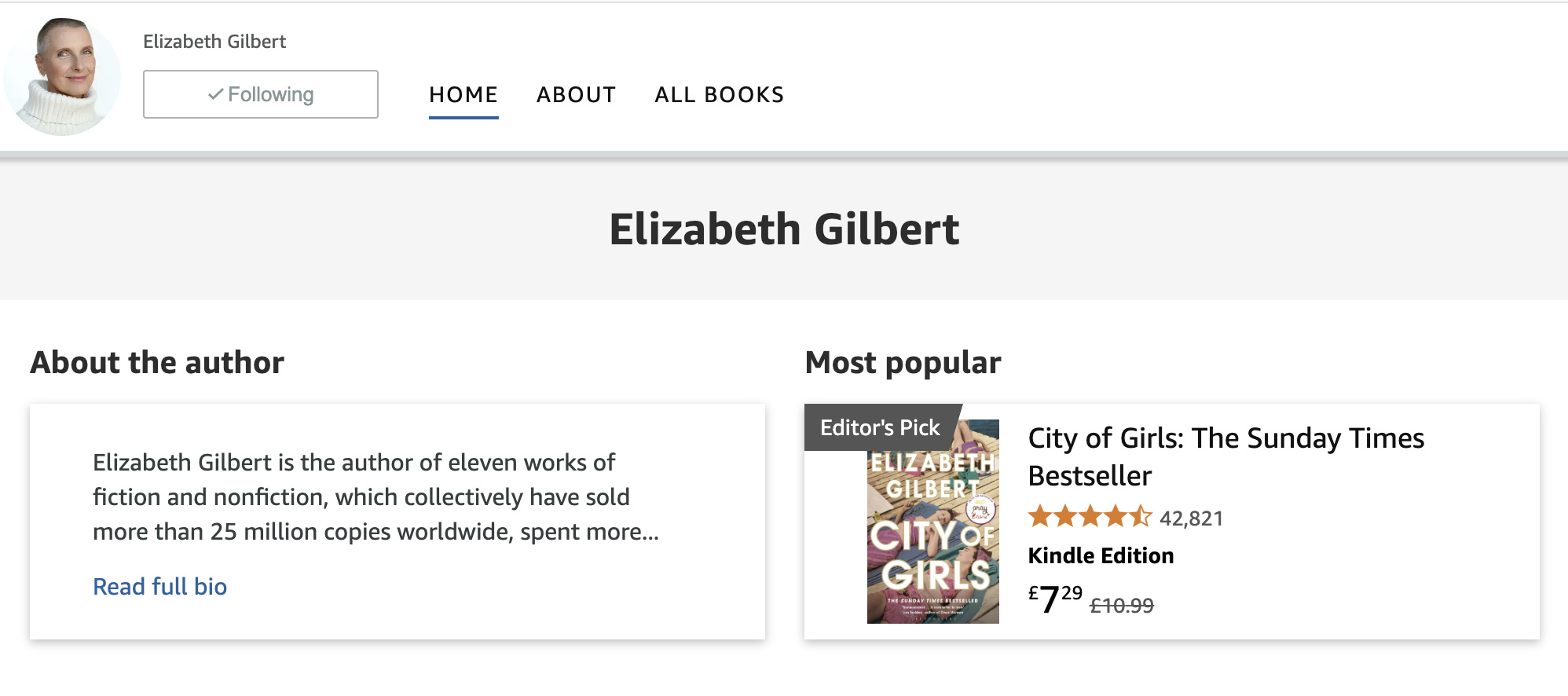
Claim your page through Author Central, add a professional photograph and write a biography that connects your experience with the subjects you explore. Check your bibliography across paperback, hardback, Kindle and audiobook editions. Amazon’s ACX guidance explains how to add books and audiobooks to your author page. Accurate associations help readers explore your work in the format they prefer.
As your catalogue develops, check that eligible companion guides, revised editions and translated books are correctly associated with you too. Podcast appearances can add to your visibility through Amazon Music, but do not assume that every episode mentioning your name will automatically appear on your Author Central page.
What happens when a reader follows me?
Following gives interested readers another route to discovering future books. Under Amazon’s Author Follow guidance, release and pre-order notifications depend on the book’s eligibility, the reader accepting Amazon marketing emails and the reader not having already ordered it. Do not assume that every new format, edition, language version or other product triggers a separate email.
That makes following worth encouraging alongside your own email list: it can help an interested reader return when you have something new available. Keep your profile and catalogue current so that the page gives them a useful view of your work whenever they arrive. Author Central supports the UK; Editorial Reviews and BookScan sales information remain US-only features.
How do I link Kindle, paperback, hardback and audiobook formats?
An author page collects your work; format linking lets customers choose editions on a book’s product page. Author Central alone does not resolve mismatched metadata. Follow Amazon’s linking troubleshooting guide:
- Match the title, subtitle, author, contributors, series, language, edition and volume across the relevant editions. Print interior type must also match where applicable.
- For matching KDP ebook and print formats, allow up to a week after each goes live for automatic linking. Claim the books in Author Central too.
- If they remain separate, contact KDP with the ebook ASIN and the print edition’s 10-digit ISBN. Its manual linking support covers KDP formats in the same account.
Audiobooks and non-KDP editions may link automatically when details match, but KDP cannot manually link those formats. Ask ACX or your audio publisher to investigate an audiobook mismatch through the appropriate support route. Different-language editions have separate product pages. A companion guide is also a separate work, not another format of the original book.
How can UK authors use A+ Content?
UK authors publishing through KDP can use A+ Content to add approved images and text to their Amazon.co.uk book pages. Use it to show readers what makes the book relevant: an original framework, a look inside, the outcomes it explores or properly sourced endorsements. Amazon’s A+ Content guidance explains UK availability and marketplace publication.
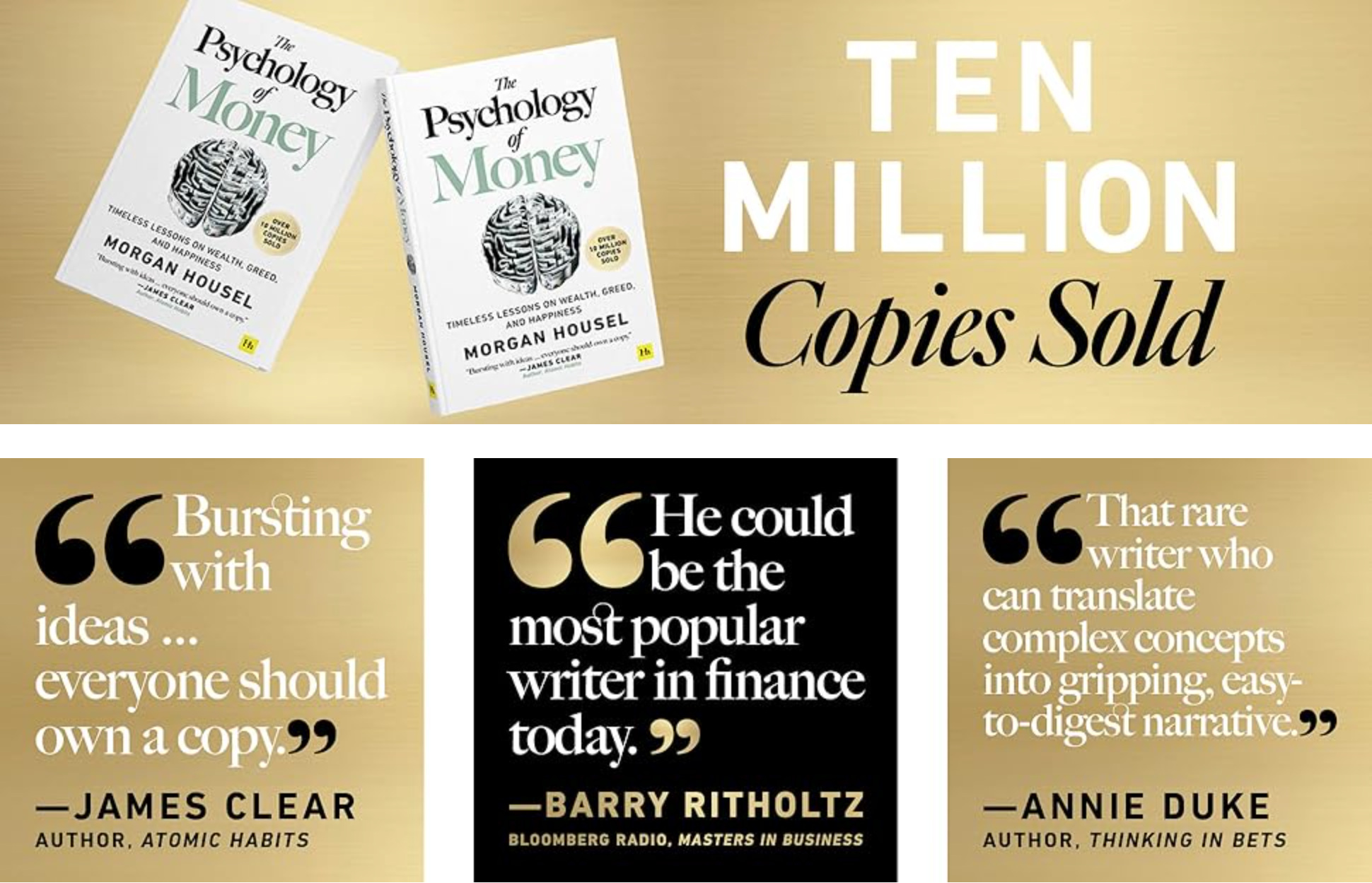
Morgan Housel: a premium presentation built around social proof
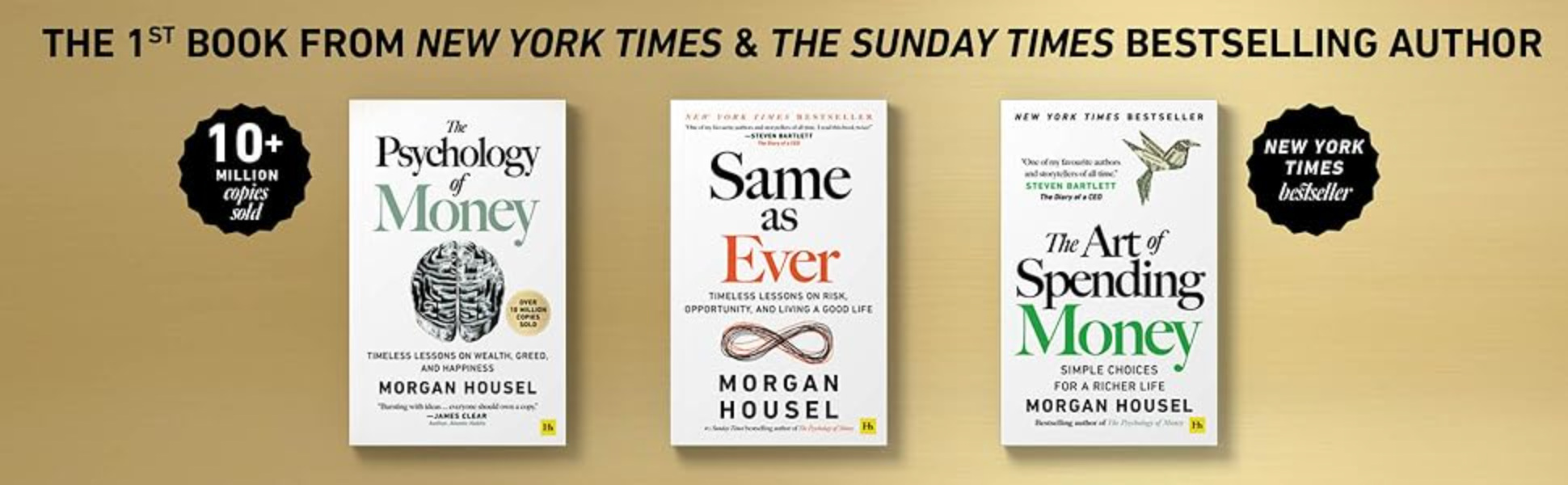
The gold and black design gives Housel’s page a premium, coordinated feel. Book images, prominent sales messaging and named endorsements reinforce one another, while the catalogue panel introduces his other titles. The useful lesson for a business author is consistency: choose evidence and design that support the professional position you want readers to associate with you.

Tim Ferriss: simple, branded and direct
The supplied Ferriss examples are for The 4-Hour Body. They use straightforward blue and red blocks, the cover and a clear statement of the book’s subject. A second banner shows interior pages and explains what readers will find inside. The design is much simpler, but its purpose is immediately apparent.
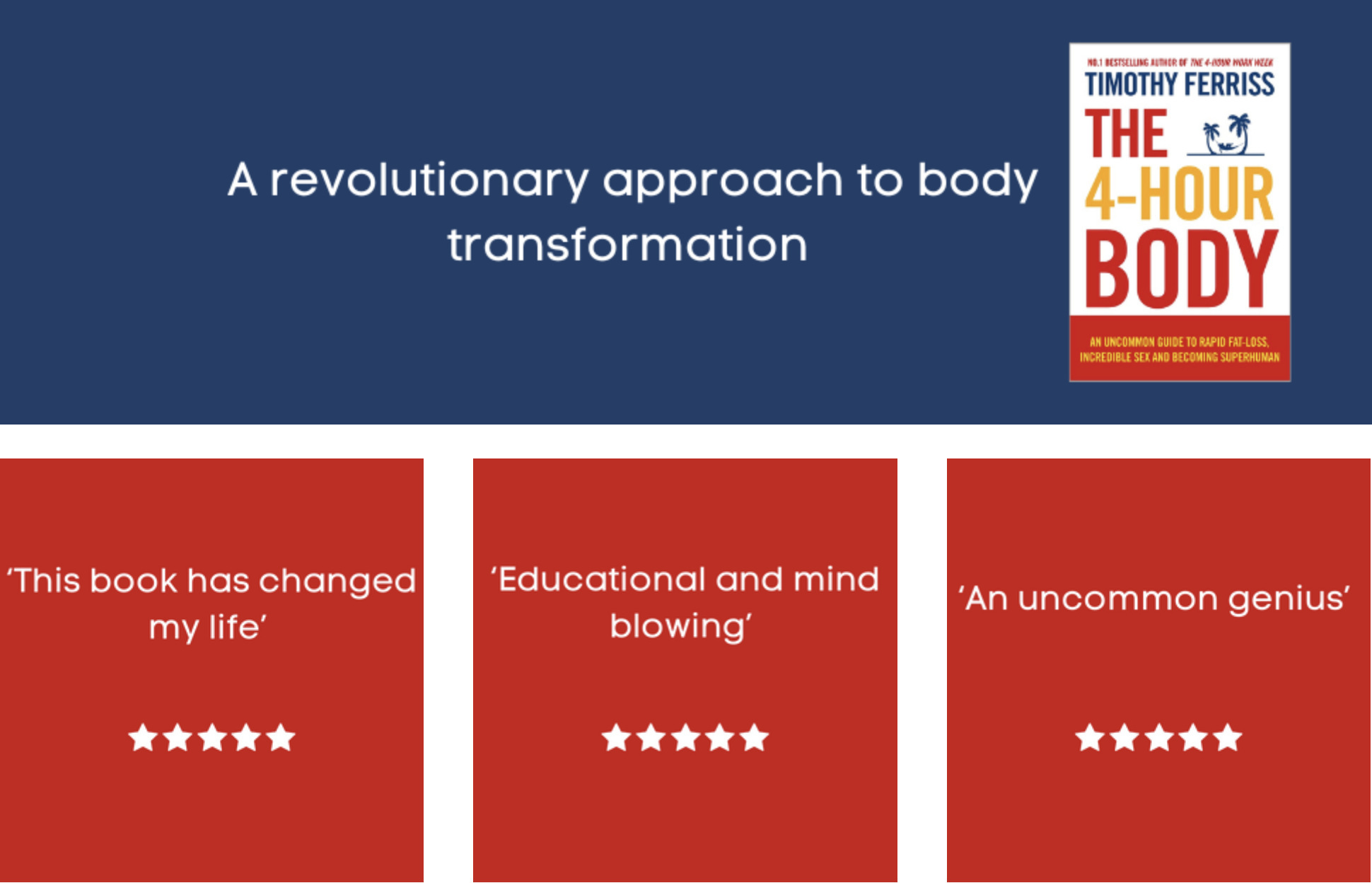
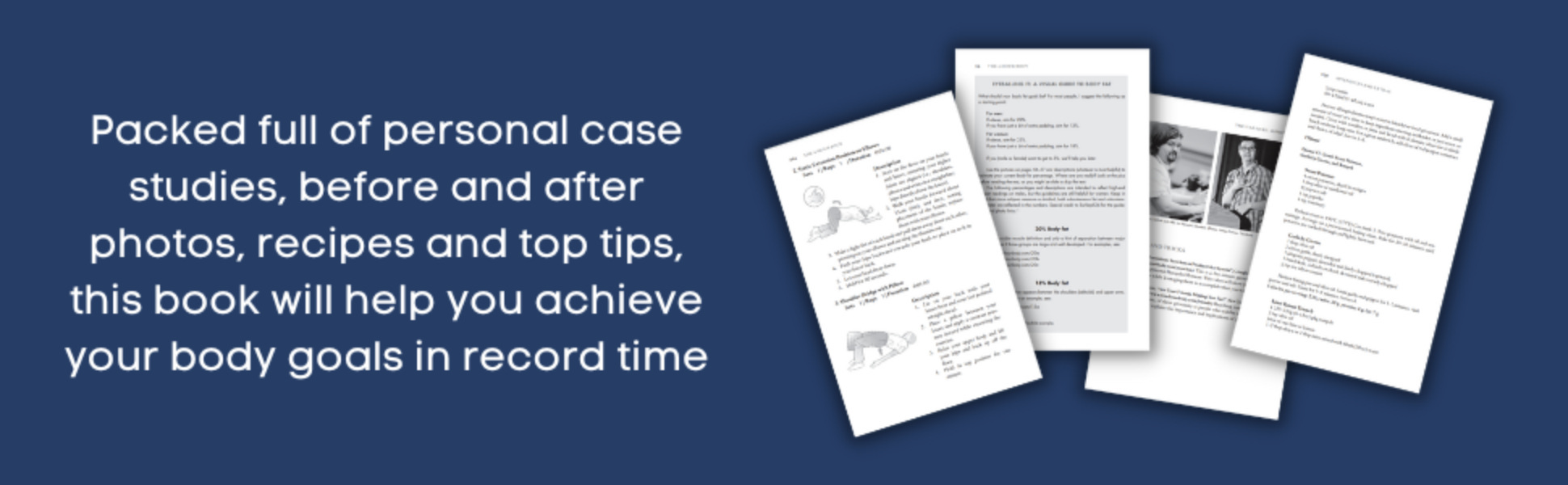
You do not need Housel’s sales history or a complex design to make A+ Content useful. A consultant could show a readable framework, explain how the book is organised and identify the situations it helps readers address. Give each panel a job, then check the mobile preview: small text embedded in a wide image can become unreadable.
Which endorsements does Amazon allow in A+ Content?
Follow Amazon’s A+ Content rules: KDP permits up to four quotes or endorsements from well-known publications or public figures, with attribution and the publication title where relevant. General customer reviews and testimonials from private individuals are not permitted. Off-site links and promotional pricing are also prohibited.
Use these screenshots to compare design choices, rather than as compliance templates. Housel’s examples contain more endorsements than KDP’s four-quote limit, while the Ferriss panels show unattributed quotations and stars. For your own submission, use the current rules and properly sourced material. A+ Content can explain your book without using endorsements at all.
How should I price my book and choose Kindle promotions?
Choose pricing around the reader, the edition, your positioning and the economics of each sale. Consider a discount only when you can explain what it is meant to achieve and how you will reach the relevant audience.
For KDP print books, royalties depend on the applicable rate and printing costs. On Amazon.co.uk, the standard print royalty rate changes from 50% to 60% at a £7.99 list price, before printing costs are deducted. Use the current paperback royalty guidance and account estimate before changing a price. A small reduction can alter your margin more than expected.
Kindle ebooks have 35% and 70% royalty options with eligibility conditions; delivery costs apply under the 70% option. Check Amazon’s digital pricing guidance and eligible price bands. Do not apply a US price example directly to the UK edition.
Should I enrol in KDP Select?
KDP Select is an optional programme with 90-day enrolment periods and ebook distribution restrictions. Review its enrolment terms against your plans for selling or sharing the digital edition elsewhere. It is a distribution decision, not a requirement for publishing on Amazon.
Another Select benefit is inclusion in Amazon’s Kindle subscription catalogue, with eligible ebook reading contributing to royalties. Consider whether that access suits how your readers consume books, alongside any plans for distributing the ebook through your own business or other retailers.
Eligible Kindle ebooks can use Free Book Promotions or Kindle Countdown Deals. Countdown Deals support Amazon.co.uk and Amazon.com, subject to enrolment, price and scheduling conditions. A free promotion and a Countdown Deal cannot both be used in the same enrolment period. Choose the offer around a prepared audience and follow-up, rather than expecting the discount to create demand by itself.
Can audiobooks join the Kindle subscription programme?
Amazon’s ACX audiobooks for KDP Select guidance now describes eligible audiobooks joining Kindle+, its subscription offer. Crucially, audiobook distribution through this route is currently US-only. It is not a general promise that UK Kindle subscribers can borrow every audiobook.
A UK-based rights holder should check the option in their own KDP and ACX accounts. The associated ebook must be live and enrolled in KDP Select; the audiobook needs exclusive Audible distribution, Read & Listen/Whispersync eligibility and a qualifying Pay-for-Production deal. Other production arrangements are not covered by this eligibility route.
For eligible titles, the KDP Bookshelf shows “Enroll audiobook in KDP Select”; account authentication may be required. Check the terms and your existing distribution agreement before enrolling. The opportunity is access to qualifying US listeners, with subscription earnings to assess separately from individual audiobook sales.
How can I advertise my book on Amazon from the UK?
UK authors can use eligible Amazon Ads campaigns to put books in front of relevant shoppers. Start with a well-prepared page and a defined test, then assess what the campaign earns and teaches you.
Amazon confirms the UK among the supported author advertising markets. Sponsored Products is a practical starting point for an individual title. Amazon’s author guide explains registration, book selection and targeting. Availability, account status, the book and the offer all affect eligibility.
Kindlepreneur’s Amazon Ads course guidance, developed by Dave Chesson with Janet Margot, emphasises relevance, keyword and product targeting, and ongoing management. Its free course page is a useful training starting point. Apply the principles against the options currently offered in your UK account; a lesson mentioning a feature does not establish UK availability.
How should I build the first campaign?
Choose one edition, one marketplace and a clear objective. Automatic targeting lets Amazon identify potential matches; manual targeting lets you choose relevant keywords or products. Keep tests understandable so that the results can guide a decision.
For keyword targeting, separate a tightly defined reader need from a broad topic such as “business”. For product targeting, examine books serving a comparable reader. A famous title with a very different promise can bring expensive curiosity rather than useful demand.
Review actual shopper queries as data becomes available. Amazon’s advertising FAQ explains match types and negative targeting, which can exclude irrelevant searches. A book for business founders, for instance, may need to distinguish organisational growth from searches about growing plants.
How many advertising keywords can I use?
The seven KDP keyword entries do not limit your advertising. Amazon’s sponsored ads limits allow up to 1,000 keywords per manual-targeting ad group, excluding negative keywords. You do not need to fill every slot: focus on keywords that are relevant to your book and its readers.
Build relevant groups through research rather than inventing hundreds of phrases from memory. Use Amazon’s suggestions, a tool such as Publisher Rocket, and search term reports from automatic campaigns to identify useful shopper language. Group similar intentions and review performance. A broader list only helps when it reaches suitable readers at a sensible cost.
How much should I budget?
Set a total test allowance you can afford, then consider the bids and available reporting. Review Amazon’s budget rules: the daily budget is an average across a calendar month, and higher-spend days can exceed that average. Check bidding and placement adjustments too, since they affect exposure.
Suppose a book sells for £10 and earns its author £3 per copy. An illustrative campaign spends £20 and generates ten attributed sales. The dashboard shows £100 in sales and an advertising cost of sales, or ACOS, of 20%.
The author earned £30 in royalties before subtracting the £20 advertising spend, leaving £10 before management costs and other expenses. At five attributed sales, royalties would be £15 and the same campaign would lose £5 on those book sales.
With these assumptions, the break-even cost per acquired sale is £3. If one in ten clicks produces a purchase, the break-even click cost is 30p. These figures illustrate the calculation; they are not campaign benchmarks.
Allow reporting to settle before judging a recent test. Read impressions, clicks, orders and spend together. Sparse impressions may prompt an eligibility or targeting check; clicks without purchases may prompt a closer look at relevance and the page. Neither pattern automatically means you should raise the budget.
Other ad formats have additional requirements. Amazon’s Sponsored Brands author guide lists a minimum of three eligible titles claimed under the same author name. Do not build a single-book launch around a feature you cannot yet use.

How can email and social media help sell more books on Amazon?
Email and social media can give suitable readers a reason to visit your Amazon page. Make that reason specific: a question the book answers, an idea worth exploring or an example that helps someone recognise their situation.
Email marketing for authors works best when subscribers understand what they signed up to receive. Introduce the book through useful thinking, explain its relevance and give one clear purchase link when appropriate. During a promotion, state the actual offer and its end point accurately.
Plan book launch strategies around preparation, availability and continued discussion. Check the live formats, delivery information and links before directing a large audience to buy. Prepare collaborators with accurate material and agree their contribution in advance. A launch needs coordination across the page, people and message.
On social media, demonstrate something from the book before asking for attention. A post about how a founder can clarify decision-making responsibility gives a leadership book context. A relevant podcast appearance or industry discussion can do the same. Continue developing fresh angles after launch, so later readers can still discover the book.
Should my listing sit live before I send launch traffic?
A buffer can be sensible, but there is no documented Amazon rule requiring a book to sit untouched for a few days so the algorithm can “calibrate”. Do not delay a ready campaign solely on that claim.
The practical reason is readiness. Amazon’s publishing timelines allow separate periods for the page, search visibility, format linking and samples. Search can take up to 72 hours after going live, and format linking up to a week. Check the actual UK page, ordering, delivery estimate, cover, description and formats before sending your main audience. Plan around those checks, rather than an unverified algorithmic waiting period.
How do book reviews on Amazon help, and how can I get them?
Reviews help a prospective reader decide whether your book is worth their time. For a business author, a thoughtful account of how someone used an idea can explain its relevance more convincingly than another claim about your expertise. Reviews sit against the book; they are not a single rating of your author profile or professional ability.
Do 12, 50, 100 or 500 reviews unlock anything?
Amazon does not publish a rule promising an organic promotional boost at any of these review counts. Nor is there a documented requirement to collect a dozen reviews in your first 30 days. Treat those numbers as possible campaign goals, not switches that activate recommendations.
Early reviews can give launch visitors useful evidence; later reviews remain valuable. A growing body of genuine feedback may strengthen reader confidence, but that is different from proving a particular algorithmic trigger. Some external promotional services set their own minimum ratings or review counts. Their entry requirements do not establish an Amazon-wide rule.
A self-published book can attract substantial reader feedback. A traditional publisher may contribute review copies, publicity contacts and distribution, but does not guarantee Amazon reviews. Agree who handles professional review submissions, advance copies and reader outreach. Publication route does not replace the work of reaching readers.
What can I do when Amazon does not tell me who bought the book?
Your KDP sales reports do not give you a buyer mailing list. A reviewer’s public name is not permission to identify or contact them privately. Build voluntary relationships through your newsletter, events and professional audience instead.
Amazon says it sends automated requests for most products, rather than every purchase without exception. Readers can opt out. The Seller Central “Request a review” tool is a retail-seller feature, not a buyer-contact facility available through an ordinary KDP account.
Invite independent readers before launch, give them time to read, then make an optional request once the page accepts reviews. Include a neutral request in your back matter and occasional newsletter: “If you have read the book, an honest review on Amazon would help other readers decide whether it is for them.” Link to the correct UK book page, and never make a resource or other benefit conditional on reviewing.
Review dos and don’ts
| Do | Don’t |
|---|---|
| Invite an honest opinion from independent readers. | Ask for five stars, supply a review script or write it for them. |
| Offer an advance copy without requiring or influencing a review. | Pay, reimburse a purchase, offer gifts or enter reviewers in a prize draw. |
| Keep requests optional and proportionate. | Exchange reviews, recruit close connections or ask staff to praise the book. |
| Accept criticism and report genuine guideline violations. | Offer a reward to alter or delete criticism, or pressure the reviewer. |
Amazon’s book-review policy expressly allows free or discounted copies without a required or influenced review. Its Community Guidelines prohibit compensated reviews and reviews involving personal or financial conflicts. Calling a paid review “honest” does not remove the incentive.
How do reviews appear, and what does “Verified Purchase” mean?
Readers use Your Orders or “Write a product review” on the book page. Amazon checks submissions, so publication can take several days and some reviews are rejected or removed. Customers must meet their marketplace’s participation criteria; buying your book alone does not guarantee eligibility.
A rating can be left without written comments, so a displayed ratings count is not necessarily the number of written reviews. Amazon’s displayed star score uses machine-learned models, rather than a simple arithmetic average. Check the wording beside the number before describing it as “500 reviews”.
Verified Purchase means Amazon has checked the purchase and qualifying price. Independent readers who obtained the book elsewhere may still review if eligible, without that badge. You cannot award the badge yourself. Cross-marketplace and edition sharing also depend on Amazon’s systems, so do not promise that a UK review will appear on every format or country page.
Are review services useful? What about Book Bounty?
First establish what you are buying: exposure to potential readers, an editorial assessment, or a promise of Amazon customer reviews. These are different services with different risks and demands on your time.
NetGalley’s UK service distributes review copies to its community and offers an independent-author package. Assess audience fit and the work involved in managing requests. Paying for distribution does not mean each recipient will post an Amazon review.
Book Bounty describes a points system: members review books to earn points, then spend points seeking reviews of their own. Its terms describe Amazon.com reviews and say it is not endorsed by Amazon. This is not evidence of a verified Amazon.co.uk review service.
Book Bounty says it prevents direct swaps, but the points-for-reviews mechanism raises an incentive concern under Amazon’s rules. That is our assessment of the mechanism, not a claim of an Amazon ruling on this provider. We would not recommend relying on it to build a UK review campaign. Factor in the time spent reading other books too.
Paying for a professional editorial assessment is different from buying customer stars. Kirkus explains its paid editorial-review model and does not promise praise. Consider whether that assessment has value for your audience and marketing; do not turn it into a paid Amazon customer review. No service’s “Amazon compliant” claim substitutes for checking Amazon’s rules.
How can I use reviews in my wider content marketing?
Ask permission to reuse a reviewer’s words and agreed attribution, or follow the publication’s licensing and excerpting terms. Use a short, faithful quotation on your website, in an email, on a social graphic or in a speaking pack. Keep the context intact and disclose a paid editorial review where relevant.
Explain why the quotation matters. Feedback about a useful delegation exercise can introduce a post about applying that exercise. Link the praise to a concrete idea instead of publishing a wall of generic approval. Website permissions do not override Amazon’s separate restrictions: ordinary customer testimonials cannot go into A+ Content, and KDP’s description rules prohibit review quotes there too.
How can non-fiction authors turn Amazon readers into business opportunities?
Connect the book’s ideas with an appropriate next step for readers who want to apply them. For an expert author, increasing book sales and creating qualified business opportunities are related goals that need separate measurement.
Within the book, a useful resource or clear explanation of your professional work can help readers continue the relationship voluntarily. A consultant might offer an exercise linked to a chapter, then explain how a workshop helps teams apply the wider approach. The resource should deliver what it promises.
Keep a record of speaking invitations, relevant enquiries, partnerships and resulting work. Ask what prompted each conversation. Amazon buyers do not become your mailing list automatically, and a campaign cannot show which reader became a client without further evidence. Our article on turning content into commercial assets explores the wider use of your thinking.
What should I measure in a practical Amazon review?
Separate the evidence you have from the explanation you are testing. This simple review can help you choose a sensible next action:
| Observation | Question to investigate |
|---|---|
| A campaign receives few impressions. | Is the book eligible and available, and does the targeting have enough relevant demand? |
| People click but few buy. | Does the targeting promise the same thing as the book page, at an appropriate price? |
| Sales rise but royalties disappoint. | What changed in the edition mix, discount, royalty rate or advertising cost? |
| Readers enquire about unrelated services. | Is the connection between the book’s promise and your current offer clear enough? |
These are diagnostic questions, not proof of a cause. Self-published authors should use the reports available in their accounts; traditionally published authors can agree a reporting rhythm with their publishing team. Ask for sales by edition and territory and the results of any paid activity, rather than a reassuring update without numbers.
Start with the weakest part of your current journey: discovery, the buying decision or the connection to your business. At WBR, our book marketing and strategic advisory work connects those decisions with your reader and commercial goals. A focused improvement gives you something concrete to assess and build on.
What do authors ask about selling more books on Amazon?
Why is my book on Amazon but not selling?
A listing makes the book available; it does not establish demand. Check whether relevant people can find it, whether the cover and description explain its appeal, and whether the format and price fit. Use available sales and advertising data to investigate before choosing an intervention.
Can I sell more books on Amazon without paying for ads?
Yes, purchases can come through search, browsing, recommendations and your own outreach. Improve the page and introduce its ideas through relevant emails, professional networks, events and content. Advertising is an optional method of reaching readers, rather than a condition of selling.
How do I sell more books on Amazon Kindle?
Check the ebook’s positioning, metadata, sample, formatting and price, then choose promotion that reaches suitable readers. Consider KDP Select only if its distribution restrictions suit your plans. A Kindle discount needs a reason for the intended audience to notice and act.
How many sales do I need to become an Amazon bestseller?
There is no fixed number across all categories and countries. Rankings are relative to other books’ activity and change over time. Record the category, marketplace and ranking accurately; a number-one category position is different from topping the whole Amazon bookstore.
How much do Amazon book ads cost?
Sponsored Products uses a cost-per-click auction, with spend influenced by bids, targeting, adjustments and budgets. Set a test allowance and calculate what an acquired sale is worth in royalties. There is no universal profitable click price for every book.
Do I need a publisher to sell books on Amazon?
You can self-publish through KDP or reach Amazon through a publisher or distribution arrangement. The right choice depends on your rights, production needs and goals. Traditional publication changes who manages key details; it does not remove your role in reaching readers.
Can a UK author advertise to readers in other countries?
UK-based authors can investigate other supported advertising marketplaces, subject to account, book and offer eligibility. Check the local edition, language, pricing and customer experience first. A campaign that works in the UK is a starting hypothesis for another territory, not a transferable result.
Will a successful first book help me get an advance for the next?
A strong sales record can support a future publishing discussion, including an advance. Publishers also assess the new proposal, audience, costs and commercial potential. Keep evidence of sales and relevant demand so you can show what the first book achieved.
Related posts
How to Find a Publisher for Your Nonfiction Book UPDATED EDITION: Agents, Proposals and What to Send

How to Smash a Physical Book Launch: 10 Essential Tips for Success

How Authors Should Use LinkedIn: A Practical Guide to Readers, Reach and Enquiries

How to Write a Leadership Book That Builds Your Authority

Book Reviews: Why They Matter and How to Get Them for Your Book

Author marketing: how to connect your book, your audience and your business