
How to Smash a Physical Book Launch: 10 Essential Tips for Success


A room full of your favourite people, a stack of finished books and a chance to celebrate something you have worked hard to create. There is plenty to love about a physical book launch.
There is also plenty to organise. Someone has to manage invitations, find the right room, get the books there and make sure your guests have a worthwhile evening. If you are the author and host, that someone cannot be you for every task.
An in-person launch is optional. An online conversation can reach people across the country without asking them to travel, and avoids many venue and hospitality costs. You can also publish and promote your book without holding a launch event at all.
In person, though, you can bring your network together in a way that creates value for everyone. Clients meet collaborators. Colleagues meet referral partners. Guests have conversations that continue well beyond your Q&A. The book gives them a reason to gather; thoughtful hosting makes the gathering worthwhile.
Here is how to decide whether to do it, organise it properly and enjoy the occasion yourself.
1. Decide whether a physical launch earns its place
Start with the purpose. Are you thanking supporters, strengthening client relationships, introducing your expertise to prospective clients, or celebrating with friends and family? Choose one main aim and be honest about it. A celebration is a perfectly good reason to host an event.
Then consider the people. If enough relevant guests can reach one location and would enjoy meeting one another, an in-person launch has a clear advantage. If they are scattered internationally, your budget is tight or your team is already stretched, an online event or small private gathering may be a better fit.
Ask three to five priority guests about the proposed location and timing before committing. Set a realistic capacity, explain what guests will gain and decide how you will assess the result. For a relationship-focused event, useful measures might include attendance, requested introductions and agreed follow-up conversations, rather than book sales alone.
Choose the format before paying a deposit. A separate online discussion can serve distant readers without the extra technical demands of running a live hybrid event.
2. Allow enough time and book the venue early
For a straightforward launch of around 30 to 50 people, allow eight to twelve weeks as a practical planning starting point. This is a suggested working allowance, not a measured industry average or a guarantee of availability.
A familiar room, a flexible date and an established guest list may let you organise something smaller more quickly. For a particular bookshop, sought-after city venue, busy seasonal date or guests travelling a long way, start enquiries three to six months ahead. Ask each venue when it can confirm the date and what it needs from you.
- 12 weeks ahead, or earlier for a constrained date: Agree purpose, likely guest numbers and budget. Appoint the organiser, ask priority guests and enquire about venues.
- 8–10 weeks ahead: Confirm the venue and terms, book practical support, decide ticketing and book arrangements, then open registration.
- 6–8 weeks ahead: Send personal invitations. Brief partners and any media outreach. Confirm the book supply plan and place orders when available.
- 3–4 weeks ahead: Review responses and expenditure before cancellation deadlines. Agree the programme, host questions, networking approach and any photography.
- 1–2 weeks ahead: Confirm attendee requirements, supplier numbers, book stock, transport and accommodation. Send the guest reminder and team running order.
- The day before: Send final directions and the contact number, charge and pack equipment, rehearse and check for travel disruption.
- Event day: Arrive with setup time, test the room, brief the team, host, finish on time and complete the handover and clear-up.
- The following day to four weeks later: Thank guests, deliver resources, make introductions, complete agreed follow-ups and review results.
Your event does not have to coincide with publication day. Check when finished books can actually reach you and allow contingency. For KDP author copies, Amazon says delivery estimates include manufacturing, which cannot be accelerated by choosing faster shipping. Work from the checkout estimate rather than a fixed promise about how many days printing takes. Source: Amazon KDP delivery guidance.
3. Choose the location for your guests and the room for your format
London is useful when your network is already there or has straightforward connections. A regional city can be just as suitable. Somewhere local may be easier and less expensive for a geographically concentrated audience, especially if clients and supporters already meet there.
Compare the total journey, not the prestige of the address. Consider rail connections, parking, the journey home, accessibility and any accommodation guests or your own team might need. Check bank holidays, relevant school holidays and major events affecting your audience.
- Independent bookshop: A book-centred conversation, browsing and signing Event capacity, availability, stock ordering, sales responsibility and unsold books.
- Coworking space or business club: A discussion for founders or professional peers Guest access, evening staffing, sound and any membership restrictions.
- Hotel meeting room or private restaurant room: A hosted gathering with refreshments handled for you Minimum spend, service charges, privacy, noise and what equipment is included.
- Community venue or partner's premises: A simple local event with a controlled budget Furniture, staffing, catering, setup, clear-up and everything you must supply yourself.
Visit or arrange a detailed walkthrough. Confirm usable capacity with your seating, book table and circulation space. Check step-free access, accessible toilets, seating, acoustics, ventilation and where coats can go. A drinks reception should still offer seats to people who need them.
Get the full booking terms in writing: total price and VAT treatment, deposit, cancellation dates, setup and clear-up access, overtime, equipment, catering and alcohol arrangements, and any insurance or other requirements the venue places on you. Name the venue contact for the actual event.
4. Set a sensible budget and decide whether to charge
For a modest 40-person launch without elaborate extras, use £1,500 as an initial working budget for a simple room, light refreshments, books and some practical help. If you choose London, need accommodation and travel for the author or team, or require additional event support, allow for a budget of around £3,000. These are illustrative planning figures to test against quotes, not UK market averages or a spending ceiling. A donated room and existing staff can reduce cash expenditure; premium venues, filming or a larger gathering can take the total above £3,000.
Plan for £1,500. Allow around £3,000 or more with London, author/team accommodation, travel or extra support. Illustrative planning figures, not a spending ceiling.
Here is one worked example:
- Venue, including setup and clear-up time: £250
- Light refreshments for 40 at £12 each: £480
- 40 books at an assumed landed cost of £5 each: £200
- Practical event support: £200
- Basic sound, badges, signage and consumables: £120
- Subtotal: £1,250
- Rounded contingency allowance (20%): £250
- Working total: £1,500
The book cost is an assumption: substitute your printing and delivery price. Treat the figures as final cash allowances when requesting quotes, including any applicable VAT and fees. This example excludes author travel, accommodation, professional photography or filming and the cost of existing staff time. Add them where needed. Keep refundable deposits visible in your cash plan, even if they are not ultimately an expense.
For context, Hackney's published private-use rate for most of its community halls is £39 an hour for bookings up to five hours. That illustrates an economical room option, not the cost of a staffed launch or a guarantee of suitability. Source: Hackney Community Halls pricing.
Yes, you can ticket a book launch. UK bookseller events use paid admission and book-inclusive options; House of Books & Friends, for example, listed a £5 admission-only launch with books available separately. Source: bookseller event listing.
Choose between free registration, paid admission, or a book-and-ticket bundle according to the audience and promise. A private thank-you celebration may suit free entry and gifted books. A public discussion may suit a paid ticket. State exactly what is included, the total price, cancellation terms and how included books are collected. Allow for booking and payment fees; do not assume a paid ticket guarantees attendance.
If covering costs matters, calculate the net contribution per ticket after its associated costs. Book sales alone may not repay the event, and that is a decision to make before you commit.
5. Appoint an organiser so you can be the author and host
You need one named person with authority to coordinate the details and handle problems on the day. That might be your assistant, business manager, a capable colleague or a freelance event coordinator. Ask your publisher what it actually provides; do not assume event management is included in your publishing package.
- Master plan, budget, suppliers, RSVPs and requirements: Assistant, business manager or event coordinator
- Venue access, room preparation and refreshments: Venue contact and agreed catering team
- Welcome, guest check-in and introductions: Colleague or briefed helper
- Interview, timing and audience questions: Host, moderator or trusted professional peer
- Books, payments, signing queue and stock count: Bookseller or another briefed colleague
- Photographs or recordings, if commissioned: Briefed photographer or videographer
One person can cover several duties at a small event, provided those duties do not compete. The person interviewing you cannot also greet late arrivals. A friend who is attending as a guest should know in advance if you are asking them to work.
Share a running order, supplier contacts, agreed spending limits and a clear route for decisions. Nominate cover if the organiser is delayed.
If you are travelling, assign responsibility for transporting books and materials separately from your journey. Confirm delivery acceptance and storage with the venue, plan unloading and return stock, and book accommodation if the return trip is unrealistic. Build in arrival time for preparation and a quiet moment before hosting. Put someone else's number on the final guest email so you are not giving directions while being introduced.
6. Turn invitations into registrations and registrations into attendance
Build a purposeful guest list: clients, suitable prospective clients, referral partners, colleagues, contributors, supporters, friends and family. Keep one registration record so responses do not disappear across inboxes and social messages.
Make individual invitations to priority guests. Explain why you thought of them and what they will gain from the discussion and the people attending. For example: “You mentioned that delegation is becoming a priority. That is central to the book, and I think you would enjoy comparing notes with the founders joining us.”
The registration page needs the venue, date, start and finish times, intended audience, programme, ticket price, book arrangements, travel and access details, and a way to tell you about dietary or accessibility requirements. Keep optional questions brief. One useful question is: “What would make this evening worthwhile for you?”
Send confirmation and a calendar invitation after registration. A week-before reminder can preview a useful discussion question; the day-before message should give directions, the entrance, the finish time and the organiser's number. Provide an easy cancellation route and manage a waiting list if needed. Remove registrants from further invitations to book.
Use your relevant newsletter and active social channels to support personal outreach. Give partners accurate wording, an image and one registration link. If pursuing publicity, pitch the issue your book addresses to relevant media and offer a clear interview contact. Do not rely on coverage to fill the room or claim unconfirmed guests will attend.
7. Keep the programme simple and protect time to connect
Yes, a short talk, drinks and networking can be the whole event. That format has practical advantages: guests hear why the book matters, have a reason to start conversations and can enjoy the occasion without committing to a lengthy programme. You do not need elaborate entertainment to justify bringing people together.
For a two-hour gathering, try this:
- 6.00pm: Arrival, refreshments and introductions
- 6.25pm: Brief welcome and a 15-minute talk or interview
- 6.45pm: Fifteen minutes of audience questions
- 7.00pm: Signing, refreshments and hosted networking
- 8.00pm: Finish
The extra five minutes around the talk allows for transitions. Keep acknowledgements warm and concise. Brief the interviewer with specific questions about the problem behind the book, rather than an open-ended invitation to describe the writing journey. Rehearse the timing and choose a talk that works without slides if the technology fails.
Use registration answers to plan thoughtful introductions. Ask a colleague to welcome solo arrivals and help them join conversations. Give guests useful name badges and enough seats. Ask permission before exchanging contact details; handing everyone an attendee spreadsheet is unnecessary.
You can add a short practical exercise if it improves the experience, but make participation optional and stay within the advertised time. Finish when you said you would.
You can go much further with themed experiences, recording corners, creative activities and personal touches. Our companion article, 7 Ideas for Your Book Launch Party That Give Guests Something to Talk About, explores those choices. Keep the operational essentials here in place whichever direction you take.
8. Check the details people discover too late
Finished books need checking when they arrive, including quantity, condition and the edition supplied. KDP proof copies are marked “Not for Resale”; use finished stock for selling. Source: Amazon KDP proof and author copies.
Agree who owns sales, prices, payment processing and unsold stock. If gifting books or including them in admission, organise collection so nobody pays twice. Put payments away from the signing point where possible, provide name slips for dedications and pack working pens.
Walk through the guest journey with the organiser: finding the entrance, checking in, leaving a coat, getting a drink, finding a seat and collecting a book. Confirm who handles late arrivals. Provide visible directions, water and appealing non-alcoholic options, and brief the catering team on confirmed requirements.
Test microphones, screens, adaptors, sockets, Wi-Fi and payments in the room. Pack chargers, a charged phone, the running order, a backup guest list and basic supplies such as tape and scissors. Have a no-slides plan and an alternative payment route if your main connection fails.
Brief the team on exits, the venue's emergency arrangements and who to contact with a problem. Check the book table and signing queue leave circulation space. At the end, someone must count stock, pack equipment, deal with rubbish and return the room or keys as agreed. You should know who is doing that before the first guest arrives.
9. Capture useful material and agree the next steps
Photography and video are optional expenses. If using them, brief the supplier on what you need: an author portrait, a clear image of the book, guest conversations and usable talk clips. For video, agree sound capture as well as pictures. Explain photography arrangements to guests and provide a way to raise concerns; agree permission before using an individual's recorded contribution or testimonial promotionally.
Give guests a clear next step such as a relevant worksheet or a way to request a conversation. Test the link or QR code and explain any email sign-up clearly. Access to an event resource should not conceal a marketing subscription.
If someone wants to discuss a business challenge, ask whether they would like a separate conversation and record the action afterwards. Your team can note questions and requested introductions, without turning every encounter into a sales approach.
Plan time to review and use the material. A recording has little value sitting untouched in a folder; a concise answer to a reader's question could support a later blog, newsletter or speaker introduction.
10. Follow up and review the result
Within a day or two, thank attendees, helpers and partners, and send promised resources. Send absentees a different message with a short recap and a way to explore the book. Follow up personally on agreed conversations and make requested introductions with permission. Assign an owner and date to every action.
Ask two short feedback questions: “What made attending worthwhile?” and “What would you change?” Keep event praise separate from a book testimonial. Guests may have loved the occasion without reading the book yet.
Once people have had time to read, invite eligible readers to share an honest review without obligation. Do not offer prizes for reviews. Amazon permits free or discounted book copies provided reviews are not required or influenced, and restricts reviews involving financial interests or close personal relationships. Sources: Amazon KDP review guidance and Amazon UK customer reviews.
Publish selected, approved photographs or discussion highlights, then review expenditure, attendance, book sales, useful connections and subsequent enquiries over the following month. Keep promises about future marketing preferences. Record event sales yourself: KDP author-copy purchases and resales do not appear in KDP Reports or generate royalties. Source: Amazon KDP author copies.
A successful physical launch gives your guests good reasons to attend and gives you the support to be present with them. You can celebrate your achievement, introduce the book's ideas and bring people together without managing the payment terminal or chasing a missing delivery halfway through your welcome.
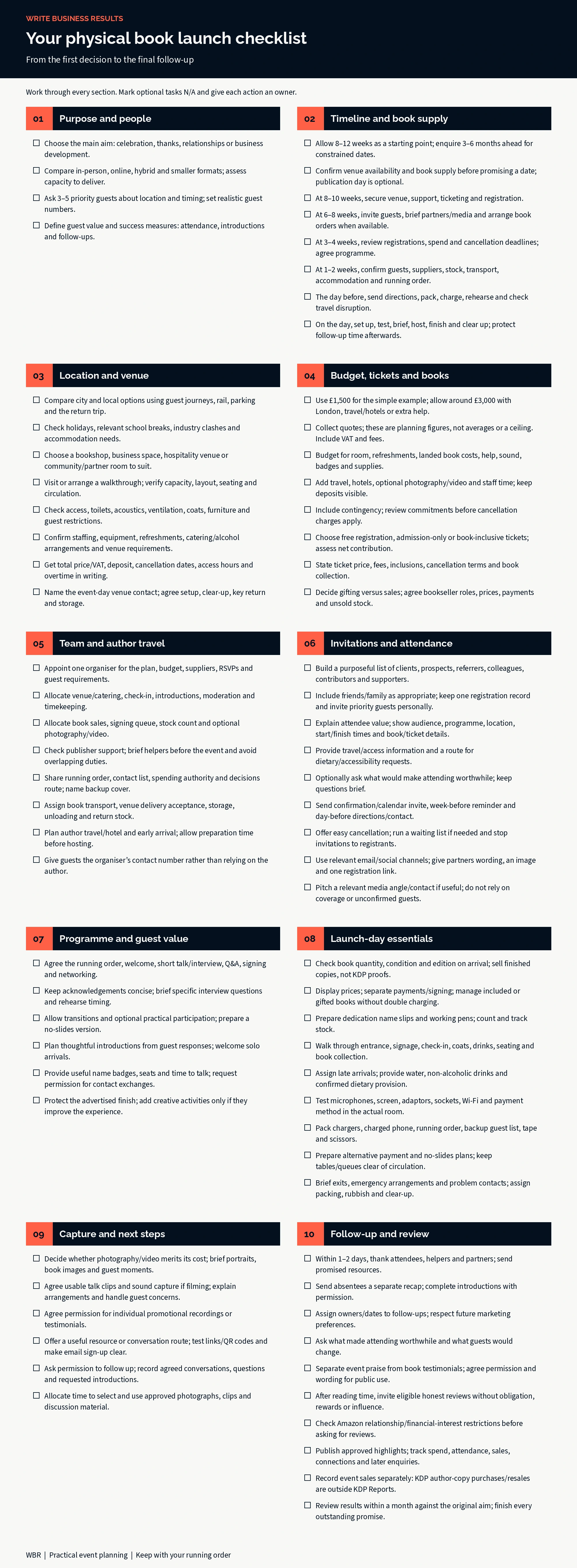
Open or save the complete book launch checklist
Book launch Q&A
How long does a physical book launch take to organise?
Allow eight to twelve weeks for a straightforward 30- to 50-person event as a planning starting point. Begin venue enquiries three to six months ahead when the date, venue or guest availability is constrained. Confirm actual availability before making promises.
Should I choose a major city or somewhere local?
Choose the place your intended guests can realistically reach and leave. A major city can serve a dispersed professional network; a local venue can work better for a concentrated audience. Compare the full travel and accommodation cost for you and your team, too.
Can I organise the launch myself?
You can lead the planning, but delegate practical control on the day. At minimum, someone else should manage arrivals and problems while you are speaking, signing and hosting. Add help where duties overlap.
What should I spend on a simple launch?
Start with the £1,500 worked example for a simple 40-person launch. Allow around £3,000 if London, author or team accommodation, travel and additional support are involved, and more if your quotes require it. Replace every assumption with actual costs. These are planning figures, not market averages; a provided room and existing support can reduce cash costs.
Is it acceptable to charge for entry?
Yes. Free registration, paid admission and book-inclusive tickets are all options. Make the value and inclusions clear. Choose a price and format that fit the audience, rather than assuming every invitation to celebrate should carry a charge.
Should I gift the book or sell it?
Gift it when that supports the purpose and budget, include it in the ticket if that is the offer, or provide a clearly priced sales point. Tell guests beforehand. If sales are handled by a bookseller, agree the arrangements together.
Is a short talk followed by drinks and networking enough?
Yes. A useful talk, a warm welcome and thoughtful introductions can make an excellent evening. Provide time and space for guests to meet one another. More activities only help when they improve that experience.
Does the event need to happen on publication day?
No. Choose a date that works for guests, finished stock and your capacity. Your online launch activity and physical celebration can happen separately.
What do people most easily overlook?
The unglamorous details: setup and clear-up access, sound, late arrivals, non-alcoholic drinks, book delivery, payment connectivity, transport, return stock and who makes the follow-up happen. Use the checklist rather than relying on memory.
Can I do more than a talk and networking?
Absolutely. A launch can become a distinctive shared experience with themed activities, memorable gifts or recording opportunities. See the companion article, 7 Ideas for Your Book Launch Party That Give Guests Something to Talk About, for the creative options.
Related posts
How to Find a Publisher for Your Nonfiction Book UPDATED EDITION: Agents, Proposals and What to Send

How Authors Should Use LinkedIn: A Practical Guide to Readers, Reach and Enquiries

How to Write a Leadership Book That Builds Your Authority

Book Reviews: Why They Matter and How to Get Them for Your Book

How to Sell More Books on Amazon: A Practical Guide for UK Business Authors

Author marketing: how to connect your book, your audience and your business